I often wonder: how many of our most important leadership decisions are shaped by experiences no one else in the room knows about? -By Linda Dyson
Mar 05, 2026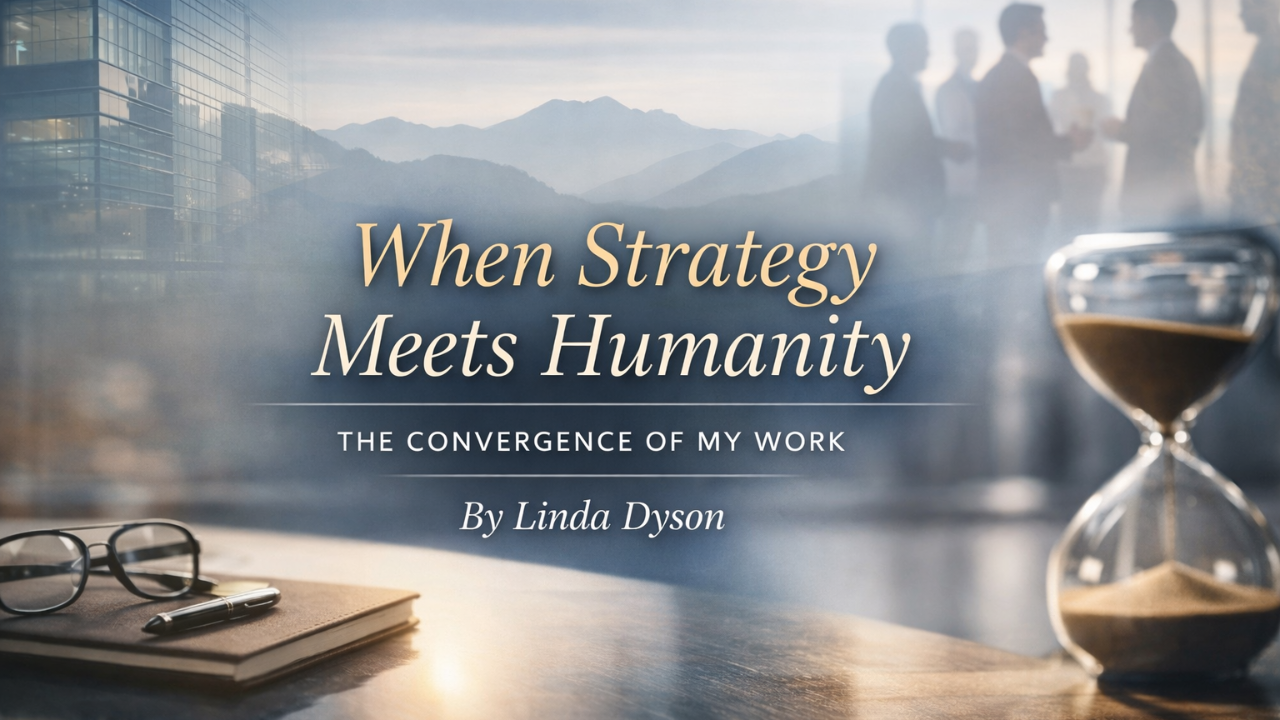
Some of the most significant leadership decisions are not made in boardrooms.
They are made quietly—while someone is navigating grief, identity shifts, health challenges, family responsibilities, or a life transition that no one else in the organization fully sees.
Over the years, I have come to understand something that rarely appears in leadership books or strategy meetings:
“The most important leadership decisions are often shaped by experiences that never appear on the agenda.”
Behind every executive title, every strategic pivot, and every leadership decision is a human being interpreting their life in real time.
Yet most professional environments operate as if these personal realities do not exist.
High-performing leaders are exceptionally skilled at continuing forward while carrying significant life transitions privately. They deliver results, manage teams, and move organizations forward even while navigating complex experiences that remain invisible to others.
But those unseen experiences matter.
They shape perspective.
They influence judgment.
They affect how leaders define risk, purpose, and success.
Organizational psychologist Tasha Eurich, in Shatterproof, suggests that resilience is not about avoiding disruption, but about developing the self-awareness necessary to rebuild meaning when the story we once believed about ourselves no longer fits.
In my experience working with leaders, this insight is profoundly accurate.
Many professionals who believe they are burned out are not truly burned out.
They are navigating unintegrated change—a shift in identity, purpose, or life circumstance that has not yet been fully understood.
At the same time, leadership researcher Brené Brown notes in Strong Ground that modern leaders must cultivate the courage and groundedness required to operate in a volatile and often dehumanizing professional climate. Drawing on her work with more than 150,000 leaders worldwide, Brown identifies the essential mindsets and skill sets required to remain centered while navigating uncertainty and change.
These insights reflect something many leaders quietly recognize:
Strategy alone is not enough.
Leadership today requires both clarity of thought and depth of self-awareness.
Where My Work Converges
Throughout my career, I have worked in environments that demanded disciplined strategy, operational systems, and strong leadership oversight.
I have held executive roles managing global initiatives, overseeing complex organizational programs, and advising companies through Maureen Scott Management & Consulting.
These roles taught me the importance of structure, governance, and strategic clarity.
At the same time, my work in pastoral care and grief leadership placed me in hundreds of deeply human conversations with individuals navigating loss, transition, and profound moments of reflection.
What I began to notice was striking.
The questions people ask during major life transitions are often the same questions leaders quietly ask during moments of professional change:
Who am I now?
What truly matters?
What am I meant to do next?
Those questions reveal something important.
Leadership is never only about strategy.
It is about how people integrate the experiences shaping their lives.
Leadership in a Time of Transition
We are living in a period where many professionals are reassessing both their work and their purpose.
Organizations are evolving rapidly.
Technology is transforming how we operate.
Professional identities that once felt stable are shifting.
In this environment, leaders are navigating both external complexity and internal transition.
Productivity systems alone cannot solve this challenge.
Leaders need the space and clarity to understand what has changed in their lives—and how to move forward with renewed purpose.
When that integration occurs, something powerful happens.
Clarity returns.
Energy stabilizes.
Leadership deepens.
The Opportunity Within Change
Every significant transition carries a quiet question:
Who am I becoming now?
Sometimes that question emerges after loss.
Sometimes it appears during success that no longer feels aligned.
Sometimes it surfaces quietly beneath the surface of a life that still looks successful from the outside.
But wherever the question begins, it can become an invitation.
An invitation to lead with greater awareness.
To align work more closely with purpose.
To build a life that reflects both achievement and meaning.
For me, the convergence of my work has been about helping individuals navigate that invitation thoughtfully.
Because sometimes the most strategic thing we can do is pause long enough to understand what has changed—
and then move forward with greater intention.