The Stressors Leaders Cannot Ignore
Mar 07, 2026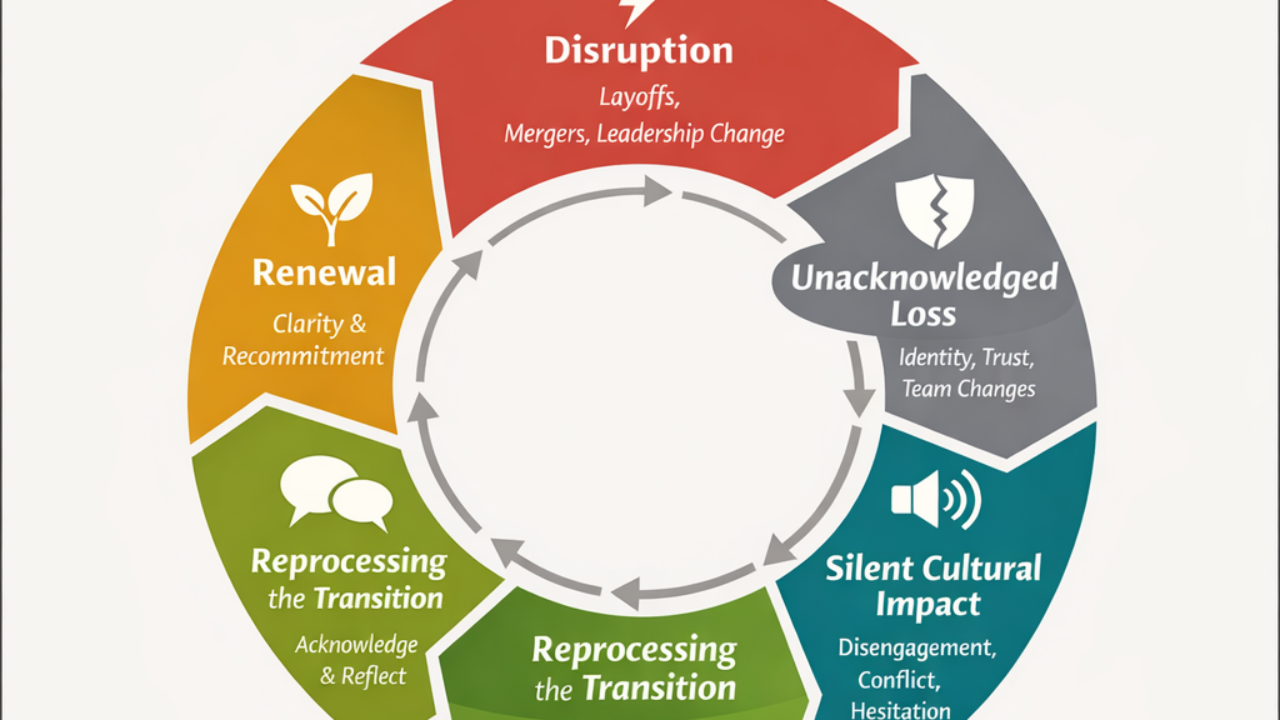
The Organizational Loss Cycle does not unfold in a vacuum.
Today’s workforce is navigating extraordinary pressure, and those pressures intensify the impact of disruption and transition inside organizations.
Several patterns are emerging across industries.
Unsustainable Workload and Time Pressure
Many teams are operating with fewer people while expectations continue to grow.
Hiring freezes, smaller teams, and constant urgency have created environments where employees feel they must continuously do more with less.
What used to be temporary bursts of intensity have become a permanent operating rhythm.
When organizations experience disruption on top of chronic overload, teams rarely have the capacity to reflect on what has changed. They simply push forward under pressure.
But unprocessed transition does not disappear simply because people are busy.
It accumulates.
Leadership Gaps and Management Strain
Another factor quietly amplifying workplace stress is inconsistent leadership capability.
Many managers have been promoted for technical expertise rather than trained in the relational skills that sustain healthy teams.
Communication.
Conflict navigation.
Priority clarity.
Psychological safety.
When leaders lack these skills, every disruption becomes harder to process collectively.
And as Patrick Lencioni notes in The Advantage, organizational health depends on trust, clarity, and the willingness to engage in productive conflict.
Without those foundations, teams struggle to metabolize change.
Economic Pressure and Job Insecurity
The economic environment itself has become a source of stress for many employees.
Concerns about layoffs, economic slowdown, inflation, and rising living costs shape how people show up at work.
When employees feel uncertain about job security or financial stability, they often respond by working harder and longer.
Boundaries blur.
Stress increases.
And people become less likely to speak honestly about challenges inside the organization.
The result is a culture where unresolved concerns remain hidden beneath the surface.
Rapid Technological Change and AI Disruption
Artificial intelligence is introducing a new layer of uncertainty for many workers.
Some fear being replaced by technology.
Others fear the opposite: that AI will simply increase expectations without reducing workload.
In many organizations, the pace of technological change is outstripping employees’ psychological readiness to adapt.
When change moves faster than people’s ability to process it, anxiety increases and engagement declines.
AI may ultimately reduce administrative burdens and help teams work more effectively.
But during periods of rapid transformation, leaders must remain attentive to how employees experience that change.
Technology can accelerate productivity.
It cannot replace human leadership.
Why These Stressors Matter
When chronic workload, leadership gaps, economic uncertainty, and technological disruption intersect with organizational change, the risk of unprocessed organizational loss grows significantly.
Teams are simply too overwhelmed to stop and acknowledge what has changed.
Instead, they move forward under pressure.
But what is not acknowledged does not disappear.
It becomes embedded in the culture.
Over time, this can manifest as:
• quiet disengagement
• loss of trust
• decision fatigue
• cultural fragmentation
The Organizational Loss Cycle helps leaders recognize this dynamic and intervene before it becomes systemic.